Showing posts with label nature. Show all posts
Twenty five years
4 months ago


These were taken from my brother-in-law's balcony a few months ago. I forgot I had them until I was looking through the photos on my camera to see if I had everything copied to my computer before erasing.
This was the entire sky that I could see, not zoomed in just as it's turning pink.
Just a few minutes later...
Zoomed in to the right side of the sky...
As it got later the pinks turned to orange...

Warning: If you're not into plants or gardening, this story may put you to sleep.
I've killed innumerable plants in my lifetime. I don't try to, but I'm not very good at caring for them. Does that make me an herbicidal maniac? Bad joking aside, I'm what most would consider a black thumb.
I tried tending to the plant beds around my house when we still lived there. Whatever I planted would die within a year or two. Most plants disappeared within days (seriously, I wondered if I'd imagined planting them). We have a lot of rabbits so maybe they ate them? I've never known.
A few I kept indoors, but I still had little success. I'd forget to water them or I'd leave them in the wrong conditions - too much sunlight or too little. But I had two faithful plants that lasted year after year.
The first was given to me by my mother-in-law. I even replanted it once to much success. I've come close to killing it a few times, but it always springs back. The tag on the plastic pot said China plant, but I have no idea what a China plant is.
My mother-in-law is great with plants. She bought one for herself, but it died. So I suppose it's a point of pride for me that it's still alive. It's probably one of those types of plants that doesn't like to be fussed over and that's why it's still with me.
The second is a plant I bought at a gift shop for my cubicle at work. It was very small at the time, but it's grown larger and more "spiky" since. When the leaves started turning brown just a few weeks after I bought it, my sister, who is the green thumb of our family, recommended that I water it less. It has moss along the top of the soil and I touch it once a week or so now to see if it needs watering and it seems to have prospered. I transplanted it once too and it's done well.
A few years ago a guy I worked with gave me a small potted plant for my desk when I moved into my cubicle. It was a nice gesture, especially after our department moved into that row and forced him out. The poor guy had been there for years and had to spend days packing. I felt it was a betrayal after such a nice welcome.
Anyway, the plant sat in a pot no larger than a teacup for years. It did OK, but it looked a little sickly. A few months ago I decided to replant it into a larger pot. As I pulled it out of the pot I saw how terribly crowded it was. There was more root than dirt. I split the plant into 4 and put 3 in a new larger pot and one back into the original.
I brought the larger into work to decorate my new cube. It grew beautifully. Within a couple of weeks it was hard to tell it was the same plant as the sickly looking thing I first re-potted. People at work told me how I had such a great, green thumb. Little did they know...
The plant grew so well that a few weeks ago I decided it needed to be split out again. So tonight I finally got around to it. In the meantime I brought my tiny teacup-sized pot into work and it sprouted two flowers within days. That's the first time I've ever seen flowers.
I suppose the conditions at work are much better for plants. They get 24 hours of florescent light, constant temperatures, watering at least once a week, and no cats nibbling on them.

 If you haven't already you must read Mark Hoofnagle's I say, Hard Cheese! article about nature... and hippies... and Monty Burns. Really, see the quote below.
Hippies drive me nuts. Not only is this just totally unrealistic, but I think it also reflects a fundamental ignorance of biology, history, and the basic infrastructure of our society. I'm of the Monty Burns school of nature.
The newest Good Planets is up at The Gypsy's Caravan. And if you don't think "awww" when you see this video you have no heart.

Wanderin' Weeta has a new edition of Good Planets up, this time with the theme of Fragility and Durability. The photos are lovely as are the words behind them.
Also, The Uncredible Hallq has the 69th Carnival of the Godless up at his place.
Watch this amazing video of lions on the hunt (be patient, the best part is near the end). Warning to those who don't like violence, this is a video of lions hunting, but if you hang on to the end, I think you'll be happy you saw it.
(HT venjanz)
Mike Hollingshed over at Extreme Instability captured some gorgeous photos of the moon and venus this weekend. You can look at the images at Mikes Moon and Venus page. (HT venjanz)
Also, the Astronomy Picture of the Day for today is on the same subject matter (below).
I'm a little late reporting on this, so you may have already seen it.
Leading scientific institutions have launched a new project to catalog an Encyclopedia of Life online. The project is ambitious, but the results will be spectacular if they pull it off.
(via many blogs)
 Prospect Magazine as an article about Why home doesn't matter (available free) which explains why parents aren't as much of an influence on their children's behaviors as everyone has assumed.
Throughout the article Judith Rich Harris describes a BBC documentary series titled "Child of Our Time", which follows the lives of 25 children for the first 20 years of their lives. She compares the findings of the documentary to her own and outlines three systems that have a greater impact on children throughout their lives.
The explanation I came up with rests on a discovery made by neurobiologists and evolutionary psychologists. The human brain, it seems, is not a unitary organ: it is instead a toolbox of various devices, each designed by evolution to perform a specific function. Each "module," as these devices are called, works according to its own rules. Each responds to a specific type of information provided by the environment; each uses the information in a particular way.
This modularity of the mind can explain some of the mysteries of development. In No Two Alike, I propose that the human mind contains three different modules for collecting and responding to information from the social environment. I call them the socialisation system, the status system and the relationship system. These systems sometimes issue contradictory orders, as vividly illustrated by the Child of Our Time episode mentioned above, "Fitting In and Standing Out." The socialisation system makes us want to fit in—to conform to our peers. The status system makes us want to stand out—to be better than our peers. We can see these motivations in people of all ages.
The purpose of the socialisation system is to adapt the child to his or her culture. This involves acquiring the local language and accent, the appropriate behaviours and customs, and the prevailing attitudes and beliefs. Acquiring the appropriate behaviours is tricky, because people within a culture do not all behave alike. Around the world, males behave differently from females and children behave differently from adults. A child who imitated his same-sex parent and behaved like an adult (other than in the context of a game) would be seen as impertinent or weird. So the child's first job is to figure out what sort of person he is—child or adult, male or female, serf's son or princeling. Then he has to figure out how the other people in his social category behave and adjust his behaviour accordingly. This is why children acquire the accent of their peers rather than that of their parents. This is why (in the Child of Our Time episode on gender stereotyping) the kids growing up in modern households, with both parents sharing the childcare chores, nonetheless take a traditional view of gender roles: the woman belongs at home, the man at work. Such attitudes come from the children's culture, not from the home, but in most cases you can't see the difference because the home and the culture agree.
[...]
The purpose of the status system is to enable children to compete successfully with their peers. In order to do this, they must acquire self-knowledge. Children have to discover how they compare with other children along a variety of dimensions. Am I tall or short, strong or weak, pretty or plain, smart or dull? Without answers to these questions, they would have no way of deciding whether to try to dominate others or yield without a fight, to make suggestions or follow the suggestions of others, to turn down potential mates in hopes of doing better or take whatever comes along. Based on their understanding of their own strengths and weaknesses, of the options offered by their environment, and of the particular set of other children with whom they must compete, children work out their own individual strategy of behaviour. "I'm not good in maths," James (the boy whose mother is a poor disciplinarian) admits. But he's popular with his peers. Every child has to find out what he is good at and place his bets on the things that are most likely to pay off. Even identical twins will find different niches to occupy.
[...]
The relationship system motivates us to form new relationships, to maintain existing ones if they're going well, and to find out as much as we can about new people we meet. The urge to learn new words and new facts gradually declines as we get older, but we never lose our curiosity about people. Gossip is a popular sport even in the old people's home. It is the relationship system that fuels our hunger for biographies and novels, and makes us want to look at photos of movie actors and sports stars. The appeal of a series like Child of Our Time, which focuses on specific children whom, little by little, we get to know, comes from the relationship system.
Tuesday was my last day at my old job. It was a bittersweet day. It was good to leave all of the stress behind. I'll miss several of the people I worked with though.
I pretty much just goofed off at work from about 9:00 onwards and left around 1:30 (though I spent quite a while talking to Josie in the lobby before finally taking off).
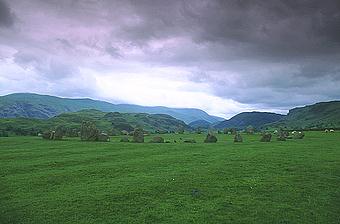
While I was basically doing nothing, I came across a website about Castlerigg, which reminded me of my trip to the UK last year. Castlerigg is beautiful, absolutely beautiful. It has a great atmosphere that makes you feel almost like you're flying amongst the mountains.
It's one of the few public places where I've felt at home. Even though there were a half dozen other people there, I felt comfortable.